Category: Lawyer Wellbeing

  • New Year, New Start? How to Re-Energise for 2026 Without Losing Your Mind (in my humble opinion).

    New Year, New Start? How to Re-Energise for 2026 Without Losing Your Mind (in my humble opinion).

    Welcome to 2026. If you’re reading this, congratulations—you survived the 2025 December rush, three office parties you didn’t want to attend, and at least one family dinner where you had to explain that no, you can’t “just quickly look over” a 50-page legal document agreement for your uncle or some other relative.

    But now it’s January. The caffeine high of the holidays has worn off, your inbox looks like a game of Tetris played by someone who is losing, and the prospect of 1,800 billable hours feels less like a professional goal and more like a prison sentence.

    How do we get that spark back? How do we transition from “Out of Office” mode to “Partner/Director/Senior Track” energy without burning out by February? Here is the Learning Lawyer guide to starting 2026 with intent (and a little bit of sanity).

    1. Perform a “Digital Autopsy” on 2025

    Before you charge into 2026, look back at the carcass of last year. What killed your productivity? Was it the endless “quick calls” that lasted forty minutes? Was it the habit of checking emails at 11:30 PM?

    The Fix: Identify one boundary you will actually keep this year. Maybe it’s not looking at your phone until you’ve had your first coffee, or maybe it’s finally admitting that “Reply All” is a tool of the devil.

    2. The “Power of Three” Rule

    If you are like me, you will know that lawyers love lists. We love them so much we make lists of our lists. But staring at a 40-item To-Do list on January 2nd is the fastest way to induce a panic attack.

    The Fix: Pick three “Big Wins” for the day. If you finish those, you’ve won. Everything else is a bonus. Remember: Rome wasn’t built in a day, and even if it were, the planning permission alone would have taken six months.

    3. Upgrade Your “Work Uniform” (Even if it’s Virtual)

    There is a psychological link between what we wear and how we perform. If you’ve spent the last two weeks in a dressing gown that has seen better days, putting on a crisp shirt (even if you’re wearing pajama bottoms off-camera) can trick your brain into “Professional Mode.”

    The Funny Slant: If you’re still working from home, please check your background. That leftover holiday tinsel hanging off the bookshelf doesn’t say “Professional,” it says “I haven’t moved from this chair since Boxing Day.”

    4. Reconnect with the “Why” (No, not the money)

    Let’s be honest: the billable hour is a soul-crushing metric. To stay motivated, you need to remember why you chose this path. Was it to help people? To solve complex puzzles? To wear a wig? (No judgment here).

    The Fix: Find one pro bono project or one interesting piece of research that actually excites you. Use it as a “carrot” to get through the “stick” of administrative filing.

    5. Movement is Non-Negotiable

    We spend our lives hunched over screens like gargoyles guarding a Gothic cathedral. This year, prioritise movement.

    The Fix: A 15-minute walk without your phone won’t make your cases collapse. In fact, your best legal breakthroughs usually happen when you aren’t staring at a blinking cursor.

    Final Thoughts for 2026

    You don’t have to be a “new you” this year. The “old you” passed the exams, got the job, and handled the pressure. You just need to be a rested you.

    Let’s make 2026 the year we bill efficiently, litigate fiercely, and actually remember what our friends look like.

    Happy New Year from me to you!

    Share the Motivation!

    Found this helpful? Or just want to hint to your boss that you need a break? Share this post using the buttons below!

    #LearningLawyer #LegalCareer #LawyerLife #NewYear2026 #WorkLifeBalance #SolicitorProblems #BarLife #LegalTech #CareerGrowth

    [ 🔵 Share on LinkedIn ]  [ 🐦 Share on X/Twitter ]  [ 📸 Post to Instagram Stories ]
  • The Future of Law Isn’t Robots — It’s Resilient Humans

    The Future of Law Isn’t Robots — It’s Resilient Humans

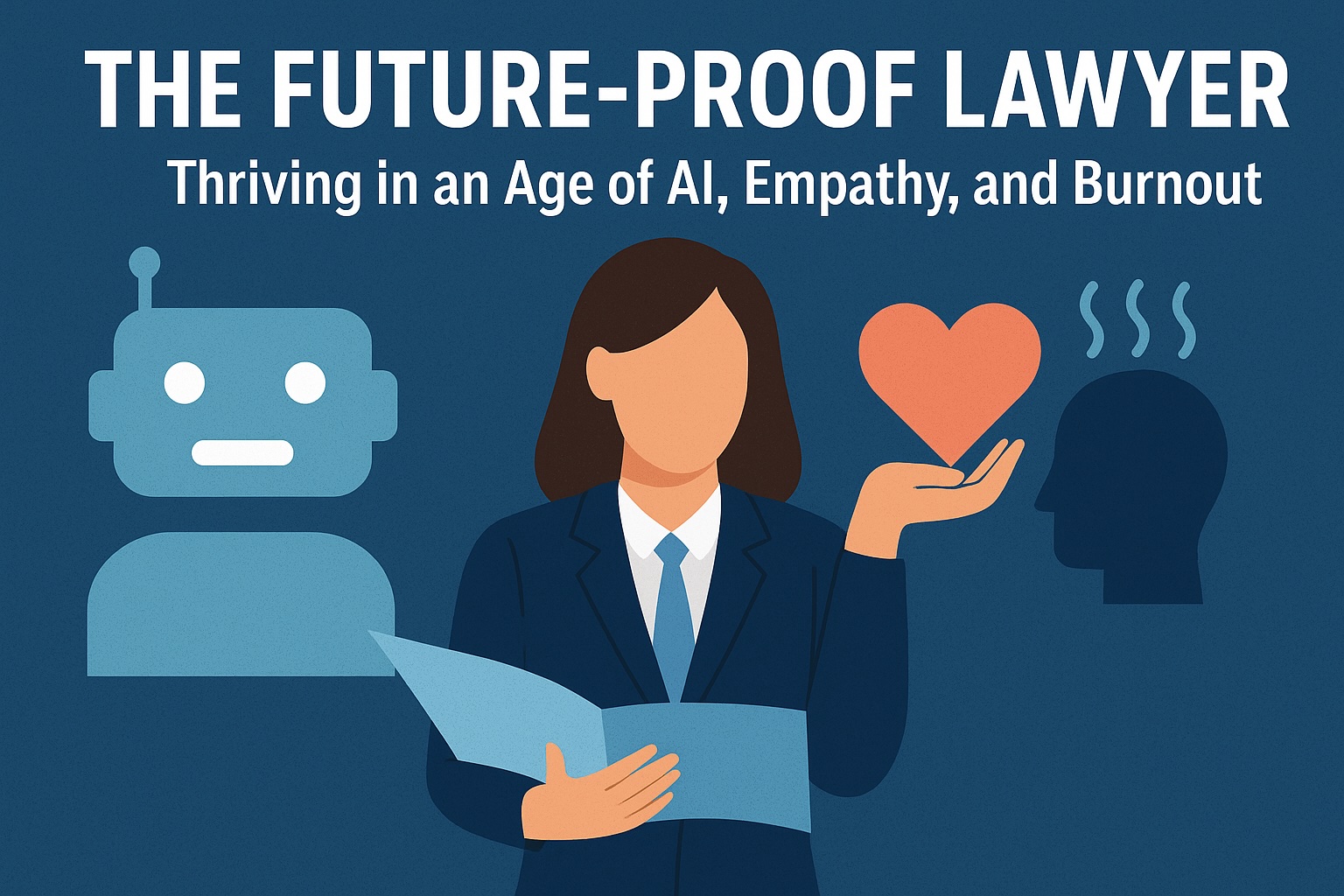
    The Future-Proof Lawyer: How AI, Soft Skills, and Sanity Will Shape the Next Decade of Law.

    If you trained as a solicitor thinking your biggest challenge would be mastering basic legal concepts and applying then to the weird and wonderful cases presented to you, you’ve probably realised that’s not how it works anymore. The real test isn’t just knowing the law — it’s staying relevant in a profession that’s changing faster than it ever has before.

    AI can now draft contracts in seconds. Clients expect instant answers and real empathy in the same breath. And law firms, for all their prestige, are quietly asking one question behind closed doors: Who’s actually ready for what comes next?

    The truth is, the future of law won’t belong to the most academic lawyers — it’ll belong to the most adaptable ones. The ones who can use technology intelligently, communicate like humans, and still keep their sanity intact.

    In this piece, we’ll look at three pillars every “future-proof” lawyer will need:

    •	how to work with AI instead of against it
    •	why soft skills are the new hard skills
    •	and how staying mentally and physically healthy will become your biggest professional edge.
    
    1. Working with AI, Not Against It.

    At some CPD courses and indeed in my own workplace, the phrase “AI is coming for lawyers” has been repeated quite a few times, so much so that it’s practically background noise. However, the reality is more nuanced. AI isn’t replacing lawyers; it’s replacing the repetitive, mechanical parts of what lawyers do.

    I have come to think of it this way: AI can summarise cases, draft first-pass contracts, and even predict litigation outcomes faster than most. The big negative is that it can’t understand context, persuasion, or trust — the parts of law that clients actually pay for.

    The solicitors who’ll thrive in the next decade are the ones who see AI as an amplifier, not a threat. The ones who can ask, “How can this tool make me sharper, faster, or more focused on the strategic side of my work?”

    The thing is that Legal tech isn’t just for big firms anymore. From contract-review bots to AI-driven research assistants, accessible tools are now levelling the playing field for small practices and solo lawyers. The question isn’t whether you’ll use them — it’s which ones you’ll choose, and how quickly you’ll adapt. From Adobe to Microsoft, where AI is integrated into the tools we use every day, it is so easy to bring up a .pdf with 30 pages and ask AI to summarise any covenants contained within it and in 10 seconds you have saved yourself an hour of reading.

    I think that If you’re a company working on AI tools for solicitors, this is your moment. The legal profession is hungry for technology that saves time without stripping away judgment.

    1. The Human Edge: Why Soft Skills Now Matter More Than Case Law.

    With the vast amount of information that is easily accessible and at the tips of everyone: knowing the law isn’t rare anymore. Everyone in your firm knows it. AI tools know it. Google knows it. What’s rare — and what clients quietly crave — are solicitors who can explain complex ideas clearly, stay calm under pressure, and actually listen.

    Legal education has traditionally rewarded precision over empathy. But the market is shifting fast. Clients want solicitors who can translate, not lecture. Partners want junior solicitors who can hold their own in a room, not just behind a screen. And in-house teams want colleagues who can negotiate, not just cite.

    The irony is, soft skills are now the hardest to master — because they take self-awareness, practice, and humility. You can’t automate empathy or presence. You build them through experience, feedback, and a willingness to sound human in a profession that often hides behind jargon.

    If you’re training the next generation of solicitor, this is your opportunity. Courses, mentorships, even communication platforms that help legal professionals grow this side of their skillset — that’s where the long-term value lies.

    1. Sanity as a Strategy: The Future Lawyer’s Real Advantage.

    There’s a quiet truth about the profession no one likes to say out loud: most solicitors are running on fumes. We normalise exhaustion. We treat burnout as a badge of honour. But in a future defined by speed, the real competitive edge will be endurance — mental, physical, and emotional.

    Because here’s what’s coming: constant change, tighter margins, and new technology every quarter. You can’t outwork that. You can only outlast it. That means learning how to protect your focus, your energy, and your ability to think clearly when everyone else is drained.

    It’s not self-care for the sake of it — it’s professional survival. The solicitors who swim, meditate, sleep properly, or just know when to step back aren’t being soft. They’re being strategic.

    For companies in wellbeing, productivity, or nutrition, this is the part of the legal story that’s still wide open. Law firms are starting to take wellness seriously, but they’re desperate for practical solutions that actually work — and that’s where collaboration with the profession can make a real impact.

    The next decade of law won’t be about the smartest solicitors. It’ll be about the ones who adapt, communicate, and stay healthy enough to keep going. AI will change what we do. Soft skills will change how we do it. And wellbeing will decide whether we can sustain it.

    If you’re building something that helps solicitors thrive — whether through tech, training, or health — now’s the time to get involved. The future-proof solicitor isn’t a concept. It’s already being built.

    ⚖️ Solicitor by day | 🚢 Cruising the seas and navigating the law | Sharing legal tips & travel tales | 📲 Follow my journey on Instagram | Threads | TikTok | BlueSky |